

News
Markets face uncertainty as geopolitical tensions rise
Monday 9th March 2026
This bulletin looks at the economic and financial implications of the conflict involving the US, Israel and Iran, which has introduced fresh uncertainty into global markets. While investors dislike uncertainty, it is important to remember that the global economic outlook at the start of 2026 was relatively positive, with expectations for stronger growth and company earnings.
Those underlying factors have not disappeared.
Financial markets reacted quickly last week. Energy prices jumped, currencies moved sharply, and equity and commodity markets became more volatile. European and Asian stocks experienced the largest declines, while the USA market held up better. Some markets, such as Korea, saw particularly sharp swings with its stock market selling off around 20% early last week before recovering 12% on Thursday. Incredibly, Korea’s market is still up around 30% since the start of 2026.
Energy-importing regions in Asia and parts of Europe appear most vulnerable to rising oil and gas prices, while the USA could be more resilient given its position as a net energy exporter. So far, the overall global market reaction has been less severe than past geopolitical shocks.
Why markets reacted so quickly
The most immediate impact has been on energy markets with oil prices surging as the conflict threatens supplies from the Middle East and shipping routes through the Strait of Hormuz which is a key corridor for around 20% of the world’s oil and gas shipments. Disruptions to tanker traffic and attacks on energy infrastructure have already pushed crude oil prices sharply higher to $90 a barrel and could potentially drive prices above $100 per barrel if supply remains constrained. It’s hard to see, regardless of Trump promises to protect tankers, that the situation in the Strait of Hormuz will improve until there is resolution to the conflict. Indeed having written this over the weekend we wake up today to see the oil price having spiked to nearly $120 per barrel and the negative impact on Asian shares overnight.
This highlights that there are still important unknowns surrounding the conflict, including how long it may last and the potential impact on global trade and energy supplies. Higher energy prices could push inflation higher in the short term and slow growth and delay central bank interest rate cuts.
The global economy continues to show signs of resilience. Recent business surveys in the USA and Europe have been stronger than expected, and global growth had been improving before the recent tensions. China has also set a growth target of 4.5–5% for 2026, reflecting efforts to support domestic demand.
Historically, markets often fall sharply at the onset of conflicts but stabilise once investors better understand the likely scale and duration of the disruption.
What are the biggest economic risks?
From an investment perspective, three key risks are being closely monitored:
1. Energy prices - If oil and gas prices remain elevated, inflation could rise again globally, affecting economic growth and interest rate expectations. Indeed the expected cut in UK interest rates at the Bank of England meeting due on the 19th March now seems to be on hold and some fixed rate mortgage rates have started to rise.
2. Trade and supply chains - The conflict is already affecting shipping and air routes in the region, which can increase transport costs and delay goods moving between Asia, Europe and the Middle East.
3. Conflict escalation - Markets are currently assuming the conflict will remain regionally contained. A broader regional war or prolonged disruption to energy supplies would create greater economic pressure.
What this means for investors
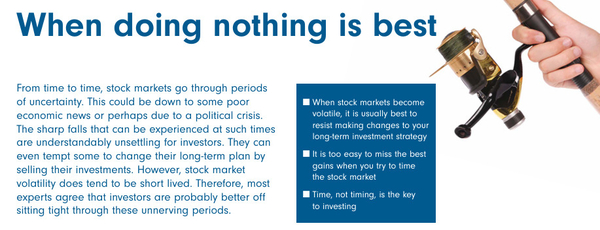
While short-term market volatility may continue, history shows that investors who react to short-term shocks often miss the recovery that follows. Maintaining a long-term perspective and staying invested remains an important principle during periods of uncertainty. Periods of geopolitical tension often create short-term volatility but do not usually alter long-term market trends. Several points are worth remembering:
- The global economy remains relatively resilient despite the conflict.
- Energy-related sectors may benefit from higher prices, while energy-importing regions could face greater pressure.
- Diversified portfolios are designed to manage shocks like these.
- While the situation will continue to evolve, the key investment principle remains unchanged: maintaining a disciplined, long-term approach is usually more effective than attempting to time markets during periods of uncertainty.
For now, the focus remains on monitoring energy markets, inflation trends and whether the conflict expands beyond the current situation. Markets may remain volatile in the short term, but long-term investment fundamentals have not disappeared. While the situation remains unknown, it is important to step back and look at what matters most for long-term investors and this Fidelity International article may help in this respect.